Catherine

It's mature!

Catherine is yet another game about duality. Yeah, there are lots of those. Ikaruga might be the most obvious and easiest example (Breath of Fire IV being the least obvious but most noteworthy). It’s not a terribly original idea for a video game anymore, and really, it wasn’t even an original concept in general by the time video games came around. I’m not a literature enthusiast, so I can’t name any examples, but I’m certain that traditional authors beat the idea into the ground long ago. Catherine however, uses it to great effect and unlike Ikaruga, does so a little more subtly. And by “subtly” I mean it’s not a core gameplay mechanic.

This duality becomes apparent if you notice the game’s logo, which is a yin-yang-esque seal that features Catherine and Katherine, the game’s two… I’m really not sure the best way to describe them. They play many roles in the game, which change depending on how you play it. They aren’t really the leading ladies and I’m even a little hesitant to call them secondary characters, because there are very few situations in which you can interact with them directly. Actually, I think the best description for the K/Catherines is “plot devices.”

The story of Catherine is a week in the life of Vincent Brooks, a man wavering under pressure to marry his longtime girlfriend (Katherine), who ends up spending a night with another woman (Catherine). The game follows Vincent for each of the seven days in this week, and possibly farther. I’ve only achieved one ending so far (of… three, maybe?), and it extended the story into nine days.

Over the course of this week+, Vincent goes through a lot, but the focus is on whether he longs more for the stability of a life of order, or the excitement of freedom. In the game, you are asked to make many decisions. The bulk of them are how you make Vincent react to the problems of the people around him, and only influence what ends up happening to those characters. There are a handful of questions asked to the player specifically though, which will shape how Vincent approaches his own problems. Every one of these choices, and even some other actions (like replying to text messages) affect a small meter that pops up and lets you know which way you’re headed. The NPC choices will tip the meter a little, depending on the answer you choose, but mandatory story choices will sometimes knock that thing a good quarter of the length of the whole bar.

The difference between this meter and the morality meter in countless other games (Mass Effect, Fable, etc) is that it not, in fact, a measure of how good or bad Vincent is. Though you can easily get the wrong idea, due to the fact that one side is blue (and is topped with a cherub) and the other is red (and adorned with a tiny devil child). This meter actually represents whether Vincent values freedom or order more, which is pretty morally ambiguous. Maybe Vince wants to live a life of freedom, not falling to the pressures of society to settle down and live his life the way he’s told to. But this doesn’t necessarily make him evil. It’s not even the <i>wrong</i> way to live. On the other hand, what makes “order” so inherently good? If you think about it even a little, it could easily be spun either way.

Therein lies the more subtle duality of the game. I mean, it’s not actually subtle because the game’s gonna be beating you over the head with that meter, but the point is that Vincent has a choice to make, which will affect what kind of person he ends up being. The subtlety is that little events are influenced by the meter here and there, but none of it makes a huge difference until late in the game, when Vincent finally has to confront his demons, whatever they may end up being.

The gameplay itself shows another kind of duality, but not within the mechanics themselves, but rather the separation of game mechanics. The game takes place over the course of a week, and you get to take control of the more interesting points of every day within that week. Each day is split into two separate play types. During the game’s “daytime” phase, which usually takes place between 8PM to 1AM, you get to watch the majority of story events unfold, and then get to hang out at Vincent’s favourite bar, The Stray Sheep. Sheep are actually a secondary theme in the game, but that’s someone else’s article. In the bar, you saunter around, talking to the various patrons and staff. About half of them are dealing with their own mid-life crisis, and you can listen to their stories and encourage them to face their problems. The other people about are generally around for entertainment purposes, generally giving cryptic hints about events to come, or cracking wise about Vincent’s predicament.

Other bar-time activities include texting the K/Catherines, visiting the washroom, changing the music via a jukebox, having drink, and playing an arcade game. Once in a while, Catherine will send a seductive photo with a text message, and Vincent won’t look at it unless he’s in the privacy of the washroom. That about all it’s there for. Also, you can have him wash his face, which will trigger a short event that will likely make you jump the first time it happens. A new music track for the jukebox is unlocked with each achievement you earn, which is great because achievements are almost never accompanied by a tangible reward. And sitting down to have a drink will (obviously) increase Vincent’s alcohol meter, which will cause him to move faster at “nighttime.” Also, when you finish a drink, the game will show you a little trivia about whatever you just polished off. It’s an odd feature, but I found it compelling and proceeded to get Vince stone drunk every night so I could hear as many as possible.

The daytime segments are cool, and do a great job of moving the story forward and building the characters, but they’re more than a little slow. That’s where nighttime comes into play. The other big dilemma Vincent is facing is that every night he gets trapped in a nightmare where he must climb a tower of blocks or else be brutally murdered. Not a huge issue normally, but due to a mysterious string of young men found to have died in their sleep, it seems quite likely that if Vincent dies in the dream, he dies for real. This is where the game does a complete 180, ripping you out of the safety of the bar and literally forces you to think on your feet or die.

The nightmare sequences’ “Levels” are made up of between one and six themed floors of crumbling block towers. They’re more like block walls, really, but the point is the same: you need to manipulate the blocks in the tower/wall to make a way to the top. On easy mode there are only a handful of really tricky parts in the second half of the game, but even on normal, you’re looking at some rather clever puzzles as early as the second night. Those puzzles are only half the problem too, because the tower below you is crumbling away pretty quickly. Having to think about a puzzle might lose you the high score, but if you really can’t figure it out, you’re dead. And of course, classic video game staples like bad guys and trap blocks are there to make life that much harder for you. Unlike the relaxed atmosphere of the bar, you really get a sense that in the nightmares, the game wants you to die.

Other notes here are that you’re scored on your speed and how many coins you pick up, and are given a trophy at the end of each night. They’re mostly irrelevant, but unlock new stages in an extra game mode if you earn them on normal or hard difficulty. The last floor of each stage is also a boss “fight,” where instead of racing against falling blocks, there’s a giant monster clawing at you heels. Occasionally they will change the properties of random blocks or shoot lighting bolts or razor blades at you. These floors are usually the most frantic, and far and away the most fun in the game.

Generally, Catherine (the game, not the character) is more than happy to keep the bar and nightmare sequences completely segregated. Though as always, there are exceptions. I’d mentioned that there is an arcade game in the bar, should you feel like whiling away your time on a game within a game. The really fun part is that Rapunzel is a tiny reproduction of the main game’s nightmare stage gameplay. Instead of the walls being hundreds of blocks high, they’re only maybe a dozen. At least, for the first few stages. There is no time limit in Rapunzel, but you do only get a certain amount of moves per stage, putting the focus on solving puzzles. These puzzles are much more devious than those in the main game too, as I’ve only managed to get to stage eight out of 64 (Maybe. There’s an achievement for beating stage 64, anyway. I assume it’s the end). It gets even deeper when Vincent receives a taunting text message that says that Rapunzel also has multiple endings. When has that ever happened before in the history of video games?

The nightmare stages also give you a change for a little reprieve in between floors. There, you’re treated to a nice little sanctuary, where every other man suffering from the nightmare stands waiting to challenge the next floor. These men all look like sheep in the dream world (which ends up being tied into the story), and some of them will have defining traits like ties or hair. These ones are people you can interact with in the bar, and will open up to you even more here, since to them, you’re the one who looks like an anonymous sheep. You can continue to encourage them to keep climbing here, and some will even share climbing techniques with you. Until late in the game there’s a merchant sheep here too, who will sell you items that can give you a small edge. But buying items costs points, and is therefore a bad idea if you want to earn gold trophies. Besides, items can be found while climbing the towers themselves, and the game (on easy mode at least) is pretty good about doling out items when they’ll be most useful.

The way Catherine draws its parallels is a fairly unique one in that it shows you two options, but then proceeds to blur the distinction between the two. Katherine and Catherine, freedom and order, the bar and the nightmare. While it goes out of its way to make it seem like there’s a proper and improper way to go about playing the game, that’s just to mislead you; it’s really all gray area. Just because you want Vince to hook up with Catherine doesn’t mean you need to be a complete ass to Katherine. But you can. Don’t like the puzzle stages and want to get back to the story? Choose easy mode and look up speed run videos on YouTube. Don’t like the slower bar sequences? Skip them. Or just play Rapunzel. The game is about growing up and taking responsibility. Or maybe it’s not, because the game is really about choices. (Actually, maybe it really is because I’ve only played through as a solid seeker of order.) The point is that Catherine wants to show you that there’s always a choice. It wants you to know that for every choice you make, there’s another you didn’t. For every yin there’s a yang. For every Katherine, there’s a Catherine.

Each must know his part

It’s over. I completed Catherine, and I got the “true lover” ending. The last stage was looooong though. Six floors! Crazy! I kind of wonder if the game is shorter if you go for other endings though, because the last two stages were brought on as direct consequences to the decisions I’d made during the course of the game. I kinda wouldn’t mind if it ended at Stage 7 if you’re headed toward the opposite ending (my current goal).

Also, this game makes use of the word “radii.” I think that’s just swell.

Completing the game seems to have unlocked a two-player mode. It’s local mulitplayer too, which is fantastic. Too many Xbox games force you to play multiplayer online, and therefore I cannot enjoy some games with others, like Crackdown, Castlevania: Harmony of Despair. It’s especially egregious in Castlevania HD, in which there really is no reason not to have local multiplayer. But I’ll leave that rant for another day.

In Catherine, on the other hand, I don’t see cooperative multiplayer working really well. Sure, most of the time it should be okay, but even in single-player there were more than a handful of instances where I fell from a height and couldn’t get back up because in creating a path to go up I had managed to destroy or otherwise block the path below me (follow?). So you’d have to not only work your way to the top, but make sure that the path persists for your buddy. That or one person sticks right behind the other, which would be missing the point completely. Or make separate paths. Where’s the teamwork in that though?

In one stage of the main game, you have an NPC that has to get to the top with you, and it took me many, many tries to finish it. Sometimes it was because -like I said before- I accidentally removed the path below me in continuing my ascent, and the slower AI player got stuck below. Other times it was because the AI is completely retarded and would not climb around to the other side of a block. Its pathfinding isn’t even that bad, it just refuses to shimmy around a block to get to a place where it can ascend. Fortunately the stage was only medium-length and a single floor, but it’s still the main reason why I’m not convinced that cooperative multiplayer is a good idea.

There’s also a competitive mode, which makes a lot more sense. Haven’t tried it yet, but it looks like a race where the players climb parallel towers. It seems like fun, and if you can cross over to your opponent’s tower and mess them up, all the better. I just wonder if it emphasizes speed over puzzles.

Looking back, I could/should probably have waited and complied all my thoughts on Catherine into an article. Maybe I still will. There’s plenty more I can add in there. It just feels like a missed opportunity.

Everybody’s got their dues in life to pay

So Catherine never ends, apparently. I mean, twice now I assumed it was over, but got faked out at the last minute. I would like to say that I’ll be wrapping it up tonight, but it might just be another pretend ending. A pretending?

Not that I’m complaining, mind you. The last few levels have been some of the most fun in the game, hitting that sweet spot between too easy and too hard. I might even say “just right,” to appropriate the adjective of a certain someone.

The story went in a totally unexpected direction though. Given that the game is a sort of spiritual cousin to the Shin Megami Tensei series, I suppose I should have seen the eleventh-hour twist coming. The game also goes the extra mile to call itself a “romantic horror,” and video games have some pretty strict rules about requirements for a game to be considered “horror.” I just thought Catherine would be different. Oh well. It’s still a great game, it just has an unfortunately silly twist.

Also, I’ve been spending little bits of time here and there with MegaMan 9, because I’ve never finished it and that’s not a game I can live with having on my pile of shame. It’s a really tough game, and while I have made progress (was previously stuck on Wily 1, now stuck on Wily 3) I feel like I’m not really learning the game, but coasting through on blind luck. I’ve been experimenting with using special weapons outside of boss fights, and it’s definitely helped my game, so I’m thinking I’ve been doing it wrong up to this point. Normally in MegaMan games I just roll through with the buster and use weapons to polish off bosses quickly. MM9 was a very rude awakening.

Is it so wrong to want a handheld version though? I’mma have to go see what that PSN thing thinks about that…

It’s time to stop running

I’m very proud of myself. I began playing Darksiders last week, and finished it yesterday. I rarely finish games at all these days, nevermind in the span of a week. Being on vacation definitely helped me along, but I’m still pretty amazed. There’s still the little matter of finishing the game on “Apocalyptic” difficulty for those last two cheevos, but we’ll take that at a slower pace.

I’m pretty sure that since the game has been out for basically forever now, everything has already been said about Darksiders. I really don’t have much to add to the collective opinion that it’s a Legend of Zelda game with God of War combat sensibilities. Which is a good thing. I was dreadfully bored with God of War, but the combat system works well in a game with more interesting non-combat. The story takes itself way too seriously and is mostly uninteresting, but is a good enough reason to beat up a bunch of demons (and angels, occasionally) and trek through puzzle dungeons. Fortunately, said story was clearly never the point of the game and most cutscenes are skippable. Yay!

The one thing I did really like is that while most of the combat stuff is lifted wholesale from God of War, quicktime events are nonexistent. Yes, you get a little “B” pop-up to inform you when you can perform a finishing move, but that’s it. No stick twirling or button-matching to be found. Also, starting the game on hard with the super armor (a carry-over bonus from my completed file, I guess?) pretty much breaks the balance of the game. Not that I’m complaining. Having an advantage that lets me breeze through my second playthrough is always fun.

Also, I started Catherine yesterday afternoon, and proceeded to play it for seven hours straight. I don’t think I’ve enjoyed such a long gaming session since Twilight Princess. Not that it was my choice or anything. Catherine really hooked me. It was like a good book, where I just could not put it down, even though I tried. I’m pretty sure I’m on the cusp of finishing the story, but I know that I’ll be hitting this one again right away.

The game is mostly talkies and has plenty of cutscenes, but the story is so engrossing that I don’t mind at all. It’s not packed with silly fluff like Metal Gear Solid games. It’s a great tale about growing up, taking responsibility, and dealing with change. Or, perhaps, none of that if you play to the “bad” side. There’s a sort of morality meter there, which pings up and down as you make choices. The game asks you to choose the answer that applies best to you, rather than the one you think is correct. It’s not always easy to tell which answer will drive the meter which way, and so far I’ve been leaning only a little towards the side of “good.” The really cool thing is that if you’re connected to Live, it’ll show a pie graph of the answers other players chose on their first play. Not a real feature, per se, but a neat little widget no less.

Climbing up the block towers is getting considerably harder with each stage (duh), and apparently I’m not great at this kind of puzzle. I’m playing on Easy mode too, which makes it all the more embarrassing. But the boss levels are super fun! The puzzle difficulty is scaled down a bit, but you’ve always got a giant monster chomping at your heels, which keeps the tension high. I think they’re easily the best the game has to offer, though hopefully I get a bit better at the puzzle stages when I bump up to normal.

Another year is gone so fast

I’ve been to the dentist three times in the last month or so, and I’ve come to the conclusion that they use dental floss made of tiny razor blades there. I’ve gotten into the habit of flossing (almost) every night, and yeah it hurt a bit at first, but now I feel no pain when I floss. My gums don’t even bleed anymore. I’m used to it. But at the dentist’s office? Hurts like a bitch.

In other news, the iPhone’s camera takes way too long to initialize. I was downloading the Virtual Console version of Final Fantasy III yesterday, and the most amazing thing happened. I tried to take a video of it, but by the time my phone’s camera started up it was over.

So normally when you download something from the Wii Shop, Mario will run laps across the screen collecting coins. Sometimes he will be Firey Mario and you can press A to shoot fireballs. Occasionally Luigi will run across instead. But yesterday, Mario and Luigi swam across the screen. In the five years I’ve owned the console, I have never seen this happen, and I’ve sunk way more money than I’d like to admit into Virtual Console and WiiWare downloads. Even my youngest brother hasn’t ever seen this, and he’s probably used the shop as much as -if not more than- me.

So yeah, I wanted at least a picture of it, but the stupid iPhone is stupid and can’t take spontaneous pictures.

This is where we’re meant to be

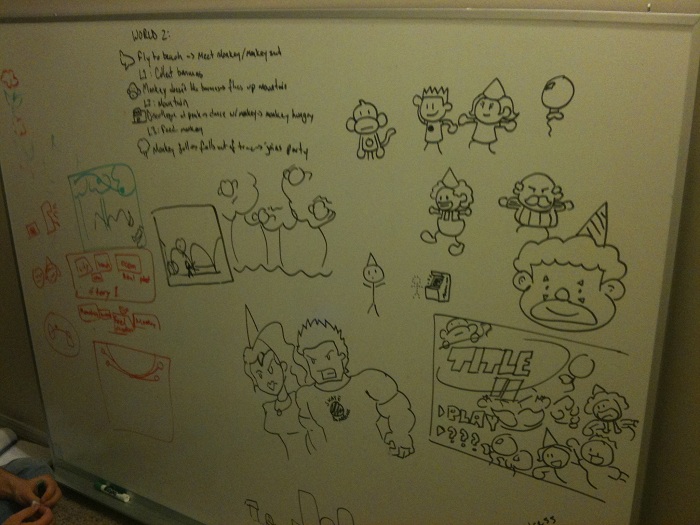
My goodness, it’s been a while since I posted an image here. That big wall of text is all well and good, but best to make sure there’s some pretty pictures in there the keep the dumber visitors happy. How about one that I made all by myself?

I may not have mentioned it, I really can’t be bothered to remember, but there’s currently a weight loss contest going on in my workspace. It’s been so gracefully dubbed “Fattypalooza” and I’ve been more interested in funny situations that arise from it than actually getting the weight off. Remember the cheesecake I told you about two posts ago? That’s this one here.

Also, referencing Pokémon makes everything better.

It all comes down to you

Remember how a couple weeks ago I was asking for a new website to read? Found one!. Guess I should have thought to look at blogs from other Talking Time patrons, but I guess sometimes the most obvious solution is the last one you’ll think of. Whatever. I have reading for a couple weeks now.

I’ve noticed that there’s one big downside for adults reading other gamers’ blogs: they write about all the stuff they like about games you’ve never played, and that makes you want to play those games. I barely have time to play the games that I choose for myself, nevermind the games other people are telling me are awesome.

Anyway, I think that for me the real selling point here is the artwork as opposed to the blogging. The words are a timesink, and nothing more. But Loki’s done a bunch of cartoony stuff for Talking Time and GameSpite, which is all so great. I’m loving all the other artwork he’s done that’s posted in his blog just as much. Almost makes me want to get back into comicing.

To be honest, I do have an idea and rough scripts for a short short short comic series. Maybe I’ll do that while I’m on vacation next week…

Earthbound

Do you like Earthbound? If you answered no, it’s because you haven’t played it.

It seems that the big thing about Earthbound is that everybody loves it for different reasons, and more often than not, they’re all little personal things. I’ve read a host of Earthbound-related stuff this week, and I recommend checking out at least Talking Tyrant Loki‘s take on it. It’s the shortest of the three links I’m posting here, and probably the easiest to swallow. Another one from a website I’ve never read before called Critical Distance gives you a sort of play-by-play of a handful of other people’s EB-related musings. The last, an absolutely mammoth review by Tim Rogers really digs into the game. It’s a long read, and it’s incredibly deep. If you don’t want to experience Earthbound after reading this, nothing will sway you.

Me, I think the thing that draws me most to Earthbound is the music. Ever since the first time I played it, the Onett theme has stuck with me. I whistle it pretty consistently, and usually when I go for a walk on a quiet day (sans iPod) I find the Twoson theme playing in my head.

More than anything, the little scene you get when waking up in a hotel and the accompanying melody are permanently ingrained on my soul. Most people miss it because you wake up and leave the room to get back to the quest, but there’s a piece of music that plays after the “good morning” melody that I’m sure is exclusive to the room after waking. Once you leave the room, it switches back to regular ol’ hotel music. I think. It’s been almost a year since I played the game, so the details are a little fuzzy.

The point is, that that one tiny moment -those ten second between when the screen fades after talking to the hotel clerk and leaving your room- makes me feel an overwhelming sense of serenity. In other RPGs, waking up after a hotel stay produces a chime and then it’s back to business. Earthbound perfectly captures that one feeling that we all get occasionally in the morning, when you wake up and everything feels absolutely perfect for a few fleeting seconds.

The little melody. The music that comes afterwards. The chirping of the birds in the background. This minor instance that is a throwaway moment in any other game has had a deeper and more lasting impact on me than any other element of any game that I can think of. You may read this, having never played the game, and think I’m nuts. Maybe you have played it, but didn’t get the same sensation. But this affected me. I can’t even describe how it works in my head. Anytime I stay at a hotel in real life, this scene invariably invades my mind.

There’s a scene in the game where you stay in a haunted hotel, and the whole process is similar, but twisted. That was when I truly realized that things were really amiss, despite the fact that the town was overrun with zombies and smelly trash can ghosts. It was emotionally distressing, to say the least.

All that, and I haven’t even gotten around to the Sound Stone Melody (called “Smiles and Tears,” apparently). This is the first song that I can remember which evoked a strong emotional response in me, and remains one of two songs and the only instrumental piece that has ever brought tears to my eyes on the merits of the music alone, the other being Queen’s “Save Me.” But while the latter brought about its response through a genuine expression of despair and loneliness, the Sound Stone Melody has a more ineffable quality to it. I don’t know how it manages to grip my consciousness so tightly, but it does. It’s one of my favourite pieces of music, and it really is beautiful.

The main quest of Earthbound is to assemble the pieces of this melody. Yes, it’s to help defeat an evil alien, but that’s besides the point. You travel the world, to these sacred places that really aren’t so extraordinary on their own. At each one, you acquire the next few bars of the tune. Once you’ve assembled them all and listen to the entire piece, you cannot help but be overcome by a wave of nostalgia, remembering all of these places, and everything you experienced on the way there. Maybe it was just a silly quest in a silly video game, but now it’s a part of you too, and that melody will bring all those feelings and memories back every time you listen to it. I used to sit on the Sound Stone screen and listen to the melody -even when incomplete- over and over, because it brought with it the absolute strangest feeling I’d ever experienced. It was like the greatest happiness and the deepest sorrow wrapped into one short, simple melody.

So yeah, Earthbound is pretty deep. I recommend playing immersing yourself in it as soon as possible. And don’t just get to the end. Walk around. Explore the world. Let it and all of its little details wash into you. Though given that everyone who writes about Earthbound in this way played it in their developmental years and is now waxing nostalgic about it, I’m not sure if an adult could properly appreciate the game. All I can say for sure is that I played plenty of video games in my youth, and none of them evoke that same warm feeling in my chest that Earthbound does.

There’s got to be another way

I spent a little time last night exploring the Playstation Store, and I really had no idea how robust its catalog is. Turns out that a rather large helping of PSP games are available in digital versions as well as UMD. I had no idea! Guess that just goes to show how far out of the loop I am these days.

Anyway, the object of my desire, Persona 3 Portable, is still costs a little more than I can justify spending at the moment, and I think with some dedicated hunting I could track down a physical copy for less, so I let it go for now. I did notice that there was a sequel to Steambot Chronicles though! And you know how I love my Steambot Chronicles.

The odd thing about it is that the download was only around 128MB. It’s supposed to be a full game, so that seems small to me. Isn’t that small? Maybe I just read it wrong. Then again, it only took ten minutes to download, so…

Size notwithstanding, it does seem like there’s quite a bit here. Any important conversations are fully voice-acted, and the game is all in 3D graphics, so no loss there. I’ve only spent half an hour with it and most of that was story blah blah blahing, so I can’t vouch for how big the game world is, but hub town is pretty big! And the gameplay seems to be identical to that of its older brother, but with what is seeming to be a much fluffier story (re: robot fighting tournament). Oh, and the loading times are super short compared to those in the PS2 game, so booya there.

I know it’s weird, but I think about Steambot Chronicles now and then, considering replaying it. Hopefully this new game will fill that hole, and maybe it’ll have some of the things I would have liked in the original. There’s one particular thing I’d like to see here, which is dungeons. The original game was a fairly open-ended game, but as far as the story goes it was almost all outdoor setpieces. There were three optional dungeons, however, that you could explore and find treasure in. This is also where you’d go for a challenge, as some of the toughest enemies were hiding in these caves. But as I said, there were only three, and I don’t remember any of them being very long. They may have had random elements though?

More to the point, I think the game would only be better with even a little more focus on these dungeons. They can still be optional, because half the fun is not being forced to do something. But they need to be a little meatier! Make at least one a real challenge, with tens of floors and save/refuel points and a boss/bosses. I think all the treasure was salable junk in the original game, so make these dungeon dives really worth the trouble by putting exclusive equipment down there.

Even if the dungeons aren’t revamped, and even if they don’t exist in this sequel, I’m hoping that it’s an otherwise fun game. Re-reading my article on it reminds me of a few of the rough spots in the original, but I only remember being nothing but delighted while playing it.